
Tamar Project in Fernando de Noronha: the sea turtles and the island that protects them
By Danilo Dirê · Updated 2026 · 6 min read
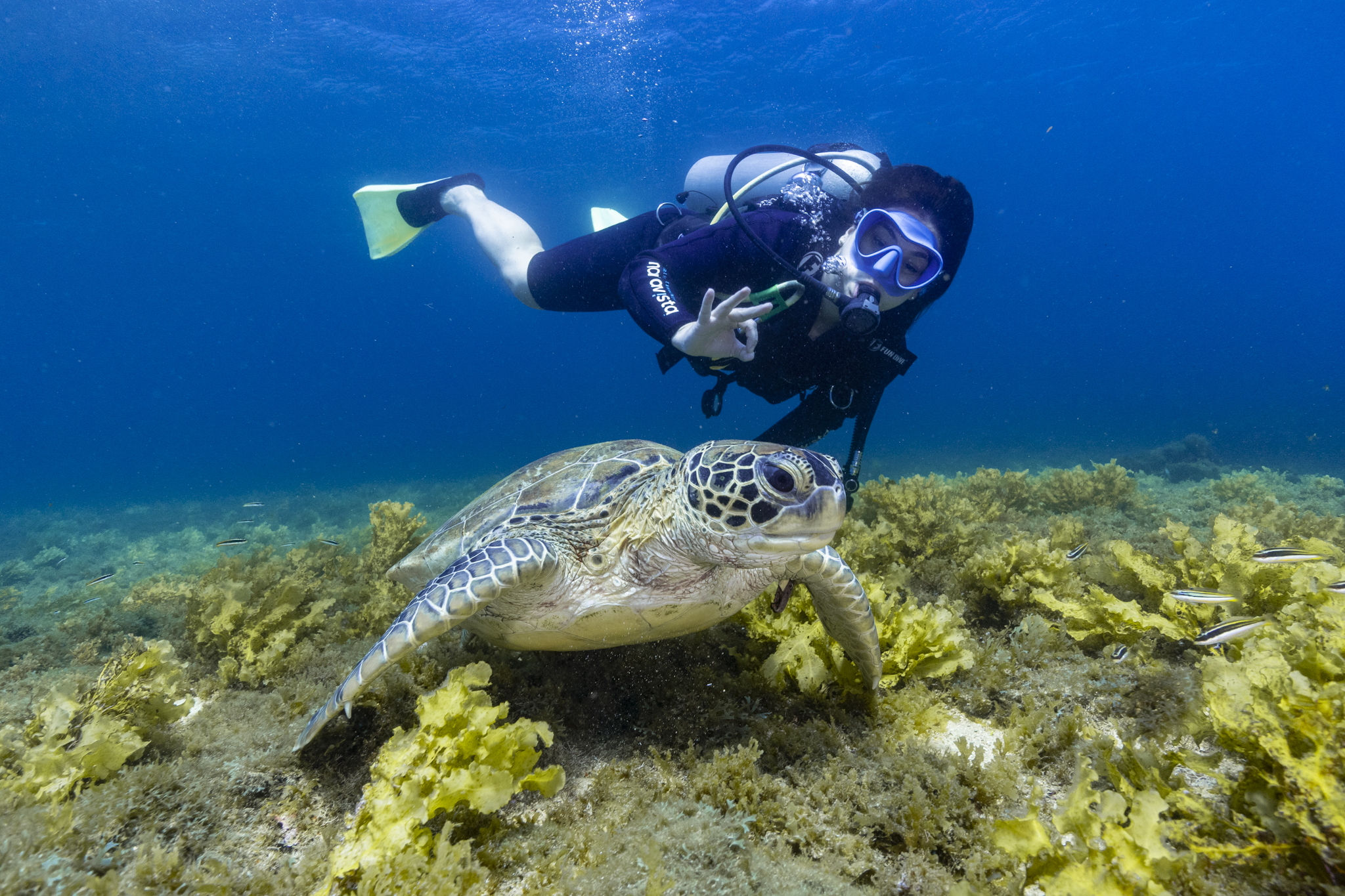
If you're planning your trip to Fernando de Noronha, getting to know the Tamar Project and the story of the sea turtles is a chapter of its own — and it helps explain why the island is so well preserved. Here, someone who lives on Noronha tells you where you're most likely to spot turtles, when the nesting season is, what the Visitor Center is like, and why the archipelago is a key player in sea turtle conservation in Brazil.
Where to see them
Where turtles are most commonly seen in Noronha
In Noronha, turtles show up most often — and are seen up close — in the port area (Porto de Santo Antônio). Sueste Bay, in turn, is an essential feeding area: its calm waters work as a natural nursery, where juvenile green and hawksbill turtles feed, grow and rest — and it also hosts the only mangrove on an oceanic island in the South Atlantic. The visit to Sueste is contemplative, done from the beach: you don't go into the water (no snorkeling, no scuba), for safety. Sueste is also one of the most beautiful beaches in Noronha.
Nesting
Praia do Leão and the birth of the Park
If Sueste is where the turtles grow up, Praia do Leão is where life begins: it's the island's main nesting area. Its importance was so widely recognized that this stretch of coast ended up becoming the seed of the Fernando de Noronha Marine National Park, created by federal decree in 1988. That's why nesting beaches are closely monitored — daily, and at night in the most sensitive areas — to protect females and nests.
Life cycle
The life cycle of sea turtles
Sea turtles have long lives full of long journeys. Although they spend almost all their existence at sea, they depend on land for one decisive moment: nesting. It's on the sand that the eggs are incubated and the hatchlings are born — and, as soon as they leave the nest, the little turtles race straight for the open sea. The first years are almost a mystery, especially in the South Atlantic: hatchlings are thought to drift with the currents, finding shelter and food among floating ocean algae. Some species, like the leatherback, spend their entire life in the open sea; others, while still young, come closer to islands and coastal regions — that's the case of those that use Noronha as a feeding ground. Growth is slow: olive ridley and hawksbill turtles take around 15 years to reach adulthood, while the others only become adults between 20 and 30 years old — and, from then on, they only leave their feeding grounds to reproduce, in a long migration back to the very beach where they were born.
Nesting season
When the nesting season happens in Noronha
Nesting is driven by temperature and happens in the warmer months. On Brazil's mainland coast, it runs from September to March; on oceanic islands like Fernando de Noronha, it happens between December and June — and here, only the green turtle (Chelonia mydas) is recorded nesting. If you're still deciding when to travel, check our guide to the best time to visit Fernando de Noronha.
History
From "flocks of turtles" to a population that had to be rescued
Fernando de Noronha appeared on the maps in 1503 and, over the centuries, passed through the hands of the Portuguese, the English, the French and the Dutch — it was a penal colony, a political prison, and even a U.S. military base during the World Wars and the Cold War. Old accounts described "flocks of turtles" on the island and in the sea, an abundance that today sounds distant. For much of that history, eating turtle eggs and meat was common — and the impact ran deep: today, Noronha has the smallest green turtle population of all oceanic islands in Brazil. It's this past that gives meaning to today's entire conservation effort.
Conservation
The Tamar Project on the island
The Tamar Project's research and protection work in Noronha began in 1984. When tourism took off in the early 1990s and the island became one of Brazil's great ecotourism destinations, the Tamar Project Foundation saw a chance to bring visitors closer to the turtles' cause. That's how the Visitor Center was born, opened in 1996 — today one of the most visited spots on the island, with around 40,000 people a year.
Visitor Center
What you'll find at the Visitor Center
The building itself already tells a story of environmental responsibility: it was built with certified reforestation timber, repurposed shipping containers, and rests on removable stilts so as not to seal the ground — no sand or stone taken from the island, an essential care in a place where the terrain wears down easily. On the visit, you walk through panels on the biology, threats and life cycle of turtles, see replicas of the five species that occur in Brazil, plus skeletons, models and videos. There's also a children's area, a cultural space, guided visits and the Foundation's shop.
How to get there
How to reach the Visitor Center
Getting to Noronha is simple: there are daily flights from Recife and Natal, about an hour long. Once on the island, the Tamar Project Visitor Center is right off BR-363 — the island's only road — on the access road to Praia do Boldró, with signs showing the way. Still unsure about flights and location? Check where Fernando de Noronha is and how to get there.
Why it matters
Why protecting sea turtles matters
Around for more than 100 million years, sea turtles are much more than a beautiful encounter for the visitor: they're central to the health of the ocean. Considered true "ecosystem engineers", they help keep coral reefs and seagrass beds healthy — which in turn supports an entire chain of species, from shrimp and lobster to tuna. As they feed, they control jellyfish and small invertebrate populations, return nutrients to the sea, and — as great migrators — carry energy between the environments they cross. Protecting turtles is, in the end, protecting the very balance that makes Noronha this paradise — and the nature that sustains the island's tourism and economy.
Frequently asked questions
What you need to know
Can I dive at Sueste to see turtles?
No. At Sueste Bay you don't go into the water — no snorkeling, no scuba. The visit is contemplative, done from the beach. To see turtles up close most often, the port area (Porto de Santo Antônio) is the best spot.
Where is it easiest to see turtles in Noronha?
In the port area (Porto de Santo Antônio), where they show up most often. Sueste Bay is also a feeding area and lets you spot them from the shore (contemplation only, no going into the water).
When is the nesting season in Noronha?
Between December and June, with only the green turtle recorded.
Where is the Tamar Project Visitor Center?
Right off BR-363, on the access road to Praia do Boldró, with signage on the road.
Is it worth visiting the Tamar Project in Noronha?
Yes — it's one of the most visited places on the island and helps you understand the nature you'll find here.
Want to go deeper? The conservation work is detailed on the official Tamar Project Foundation website.